Divorce Coach Cambridge UK: What I Do and How I Support Clients and Professionals

Over the past year, I’ve been asked the same question many times; by lawyers, mediators, and financial advisers working with separating clients, both within the Cambridge community and across the UK: “What does a divorce coach actually do?”
It’s a good question. And an important one. Because while the term “divorce coach” is increasingly used, it can mean quite different things depending on who you speak to.
My answer is usually this: There are many ways to approach this work, but I see my role as a bridging service; sitting alongside clients and professionals to support the human side of what is often treated as a purely legal or financial process.
A bridging role in a complex process
Divorce does not happen in neat categories. Legal decisions are shaped by emotional states. Financial outcomes are influenced by relational dynamics. Communication patterns can either support or derail progress entirely. That is where I work.
As a divorce coach based in Cambridge UK, working with clients locally and across the UK, I often sit in the space between:
Clients and their own emotional experience
Clients and the professionals supporting them
The emotional reality of separation and the practical decisions that need to be made
The aim is not to replace legal or financial expertise, but to support it; by helping clients engage with the process more clearly, calmly, and constructively.
What makes my approach different
My work is shaped by both how I have trained, and the perspective I bring into this space.
1. Grounded in psychological, relational, and communication expertise

My approach is shaped by a combination of psychotherapy training, academic study, and professional experience.
I am currently training as a psychotherapist, having previously completed a counselling qualification with distinction. This training informs how I understand emotional processes, relational dynamics, and the impact of stress and trauma on thinking and behaviour.
Alongside this, my academic background in social and political sciences at the University of Cambridge has shaped how I think about systems, power, identity, and the wider contexts in which relationships and decisions sit.
Before moving into the field of counselling and coaching, I also spent a number of years working in senior communications and marketing roles. This experience continues to inform my work, particularly in supporting clients to:
Communicate clearly under pressure
Navigate difficult conversations more effectively
Make sense of complex information and advice
Taken together, this means I am often working at the intersection of:
Emotional experience
Relational patterns
Communication dynamics
Practical decision-making
So the work is not just about what to do next, but about creating the conditions in which clearer, more grounded decisions become possible. In many ways, my work sits in the spaces where these different disciplines meet; which is often where the most meaningful shifts happen.
2. A neutral, non-biased perspective
Another aspect that sometimes surprises people is that I have not been through a divorce myself. And for some, lived experience in this space can feel reassuring, and it can absolutely be valuable. But at the same time, I have found that many clients and professionals appreciate working with someone who comes without a personal narrative shaping the process.
This can help create a space that is:
More neutral and less assumption-driven
Less likely to impose interpretations or labels
Focused on the client’s experience, rather than comparisons
In my work, I am careful to stay within my scope; not offering legal advice, not making diagnostic claims about an ex-partner, and not projecting meaning onto a situation without careful exploration.
And this can really make a difference; because in an already complex process, clarity, boundaries and thoughtful reflection can make a significant difference to how things unfold.
What is divorce and separation coaching?
At its core, divorce coaching helps you think, feel, and act more clearly during one of life’s most destabilising transitions.
It sits alongside legal and financial advice, not instead of it.
Where your lawyer helps you understand your rights, and your financial adviser helps you understand your options, my role as a divorce coach in Cambridge working across the UK is to help you:
Make decisions you can live with, not just react to
Understand your emotional responses, rather than being driven by them
Communicate more effectively with your ex-partner and professionals
Stay grounded in your values, even when things feel chaotic
For professionals reading this; it’s often the difference between a client who is overwhelmed and reactive, and one who is able to engage constructively with the process.
Where I work
I am a divorce coach based in Cambridge UK, and I work with clients both locally and online across the UK.
This means I can support you whether you are:
Looking for a divorce coach in Cambridge
Based elsewhere in the UK and seeking online support
Working alongside local or national family justice professionals
How I work alongside family justice professionals
I work closely with lawyers, mediators, and financial advisers as part of a wider support system. From a professional perspective, this often means:
Supporting clients between meetings so they arrive more regulated and prepared
Helping clients process advice, reducing repeated questions or confusion
Reducing escalation and conflict where possible
Offering a space for emotional containment that does not sit within the legal role
As a divorce coach in Cambridge working with professionals across the UK, I also deliver training and workshops on topics such as:
Trauma-informed client work
The window of tolerance in practice
Vicarious trauma and professional wellbeing
Because this work impacts professionals too.
Collaborative practice and integrated support
I am a strong advocate for collaborative and multidisciplinary approaches to separation.
This might include working alongside:
Collaborative lawyers
Mediators
Financial advisers/planners
Therapists
The aim is to create a process that is not only legally sound, but also psychologically informed and, where possible, less adversarial.
I am also a member of Resolution, a community of family justice professionals committed to a more constructive, non-confrontational approach to separation. This means I work in line with principles that prioritise reducing unnecessary conflict, supporting respectful communication, and helping clients move towards outcomes that are more thoughtful and sustainable, particularly where children are involved.
In practice, that often means valuing Non-Court Dispute Resolution (NCDR) and collaborative approaches, where appropriate; for example through mediation, collaborative law, solicitor negotiation, or other out-of-court processes that can reduce stress, cost, and escalation. At the same time, these approaches are not suitable in every case, particularly where there are concerns such as domestic abuse, coercive control, serious power imbalances, or where safety and fairness would be compromised.
For clients, what this means is that my focus is not on pushing one route at all costs, but on helping you think clearly about what approach is most appropriate, protective, and workable in your particular circumstances.

Examples of how I support clients
Every situation is different, but some common themes in my work as a divorce coach in Cambridge UK include:
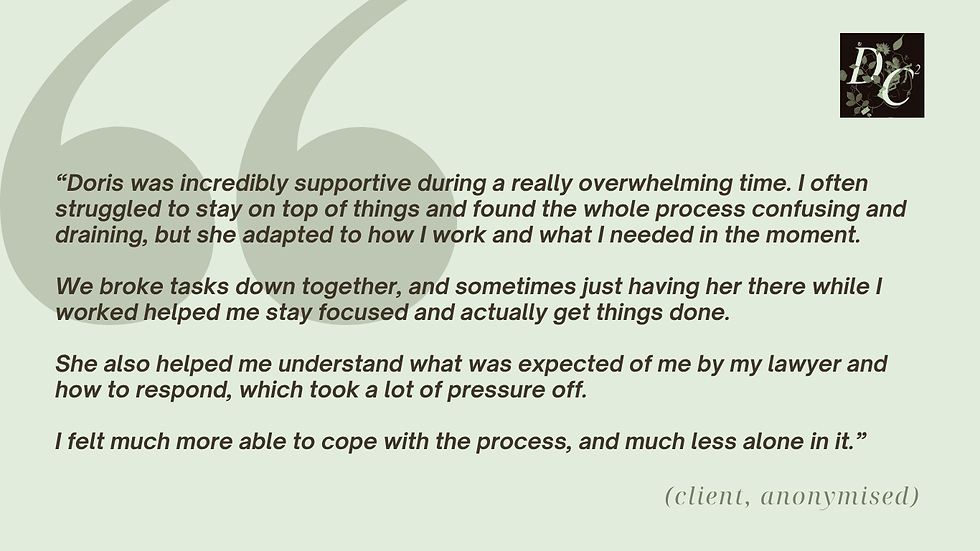
Supporting neurodivergent clients or those with complex health needs; where the process can feel particularly overwhelming.
This might include helping break down paperwork into manageable steps, pacing tasks in line with energy levels (for example with chronic fatigue), or using approaches like body-doubling (working in parallel) to help an ADHD client stay focused and get things done.
Helping clients engage more effectively with their legal and professional team
For example clarifying 'What does my lawyer actually need from me next?', organising information, or preparing for meetings so advice can be better understood and acted on.
Working alongside the wider professional network
This includes lawyers, mediators, financial advisers, or domestic abuse specialists, to help ensure communication is clear, priorities are aligned, and the client feels supported rather than pulled in different directions.
Supporting clients in high-conflict or emotionally reactive dynamics
Helping them recognise triggers, pause before responding, and communicate in ways that are more contained and less likely to escalate the situation.
Holding space for decision-making under pressure
Where clients feel torn between options, and need support to slow things down, think more clearly, and make decisions they can live with longer-term.
For clients, it often means feeling a little less alone, and a little more able to navigate what can be an incredibly disorienting time.
For professionals, that often means clients who are more regulated, more prepared, and more able to engage constructively with the process.

Who my coaching work is for
A final thought
Divorce is often treated as a problem to solve, but it is also a process to move through.
And how you move through it matters; not just for the outcome, but for your longer-term wellbeing, your relationships, and your sense of self. That is the space I work in.
If you’re looking for a divorce coach in Cambridge UK
If you're navigating this yourself, or supporting clients who are, I'm always happy to have a conversation.


Comments